On Henry Shukman’s “Original Nature”

The following is a short piece I wrote up about a series of meditations by Henry Shukman on the Waking Up app. It was published over in the Good Enough For Me magazine.

Meditation teacher Henry Shukman released a series on the Waking Up app this year called Original Nature. Poet, author, and spiritual director emeritus of Mountain Cloud Zen Center in Santa Fe, New Mexico, Shukman blends traditional Buddhist principles with accessible modern interpretations and metaphors, delivered in a soothing English accent.

Each of the seven sessions is about thirty minutes long. This was a nice timeframe for getting my morning started, and I often replayed the sessions over the year with and without coffee.

As I first sat on my cushion I would follow his instructions to arrive—”sometimes it can be a bit like, if you can imagine a nervous shy horse being gently guided into its stable. Actually a nice place for it to be, but it may not terribly like the transition from the open air, the outdoors, into the stable, even though it’s got comfortable clean straw, and a manger of fresh hay.”

In the same way, he says, it can take a little coaxing for us to come and inhabit the moment.

Similar metaphors helped deliver me to a stillness that I could return to throughout the day. Allowing awareness to “seep in,” as if the sense of self was “like a piece of old wood” that’s afloat in the ocean, becoming more waterlogged, I found myself connecting to a larger realm wherein creativity and kindness felt more accessible.

This year Shukman helped nourish my heart by pointing out ways to irrigate it. I recommend this series, as well as The Koan Way and Original Love, also found on Waking Up.
A Note on Teaching Wendell Berry in the Anthropocene

Every fall I teach environmental literature, a course which ranges over the terrain of environmental writers from Thoreau up to Rebecca Solnit. About halfway through we read Wendell Berry’s essay “Preserving Wildness.” Many of my students take a negative view of humanity in relation to nature. It makes sense. We’ve discussed why starting on night one, and continue to do so until finals week. Sometimes I don’t get around to an important except from Berry’s essay wherein he offers an alternate, deeper frame by which to view humans and our place in nature.

“We are creatures obviously subordinate to nature, dependent upon a wild world that we did not make. And yet we are joined to that larger nature by our own nature, a part of which is our self-interest. A common complaint nowadays is that humans think the world is “anthropocentric,” or human-centered. I understand the complaint; the assumptions of so-called anthropocentrism often result in gross and dangerous insubordination. And yet I don’t know how the human species can avoid some version of self-centeredness; I don’t know how any species can. An earthworm, I think, is living in an earthworm-centered world; the thrush how eats the earthworm is living in a thrush-centered world…” (from the American Earth anthology, p. 526). 

He goes on to argue that we differ from worms and birds by our ability to “do more” on our own behalf than is necessary for our survival. How much is enough for a happy life is both an ancient and ongoing argument. Often, he argues, the answer is less. He wants readers to remember we are sharing the world, “both with each other and with other creatures.”

Continue reading

Puppyhood and Wildlife

A coyote showed up near our place the day after we brought our puppy home. We first spotted it during an early attempt at crate training. Once the cage door swung shut Oni began to whine. It turned to yips, concluded with full blown howls, and after a brief ceasefire started all over again. I went to the window and looked out at the dewy morning field. The coyote was trotting towards our apartment.

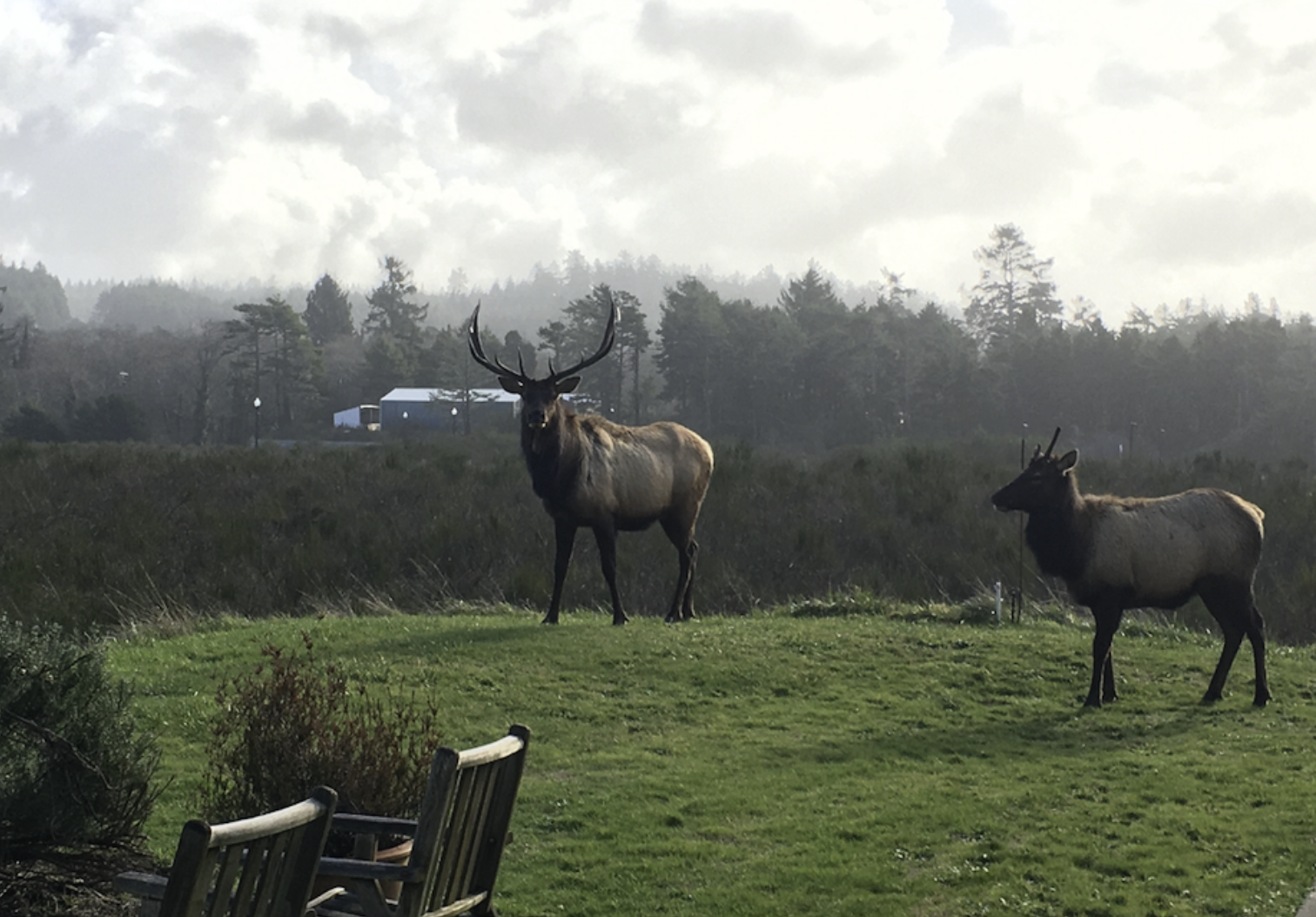
The field is bordered by a short hill topped by a grassy landing where kids play and a shared greenhouse sits, a buffer zone between humans and wild animals. There were a few evenings when a tagged elk made appearances, putting him twenty feet from our front doors, but it was relocated shortly after.

To see the landing breeched by the coyote that morning stopped my breath.

Continue reading

Running in the Dark

Training for a longer race that started in the dark, I wanted to practice running in the woods with a headlamp. Mist streamed across the bobbing cone of light as I entered the forest. It was just after five am, a clammy overcast morning in early October.

We had watched an episode of Stranger Things the night before. I tried to block out thoughts of levitating children as I descended the hill down to King Slough. Of course, blocking thought doesn’t really work, and as my shoes crunched along the gravel road I shifted to asking myself what a reasonable response to a ghost would be.

Continue reading

Our Herd

Previously published in the Last Word on Nothing and Newport News Times

We first saw the elk in September. Our route to the Wilder forest passed the Yaquina Bay, and there, between the road and mudflats, was an antler rack we initially mistook for a willow tree. 

Our neighbor said it was likely that hunters chased them out of the hills. That they were a smart herd. 

We saw them again in October, this time eating pickleweed behind the Hatfield Marine Science Center. They lifted their heads and eyed us briefly. A couple nights later, on the same path, we nearly walked into the bull before he raised his head. For no tactical reason other than that it felt vaguely respectful, we pulled our headlamps off and waved them on the ground as we backed away.

Shortly after, Hatfield security hazed them off the grounds, and the herd reemerged in the field outside our place.

Continue reading